

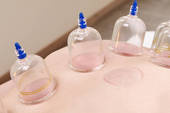
Cupping therapy is an ancient form of alternative medicine in which a local suction is applied on the skin, using glass or plastic cups; practitioners believe this mobilizes blood flow in order to promote healing.There is reason to believe the practice dates from as early as 3000 B.C.; the earliest record of cupping is in the Ebers Papyrus, one of the oldest medical textbooks in the world. It describes in 1,550 B.C. Egyptians use of cupping. Archaeologists have found evidence in China of cupping dating back to 1,000 B.C. In ancient Greece, Hippocrates (c. 400 B.C.) used cupping for internal disease and structural problems. This method in multiple forms has spread into medicine throughout Asian and European civilizations. Broadly speaking there are two types of cupping: dry cupping and wet cupping (controlled medicinal bleeding) with wet cupping being more common. The British Cupping Society (BCS), an organisation promoting the practice, teaches both. As a general rule, wet cupping provides a more "curative-treatment approach" to patient management whereas dry cupping appeals more to a "therapeutic and relaxation approach". Depending on the tradition practiced, and the wishes of the client, the cupping treatment may be accompanied by prayers.
Traditional Chinese medicine cupping
In traditional Chinese medicine (TCM) cupping is a method of applying acupressure by creating a vacuum on the patient's skin to dispel stagnation—stagnant blood and lymph, thereby improving qi flow— and is used to treat many common medical conditions, including musculoskeletal pain. Oriental medicine practitioners practice both wet and dry cupping methods.
Dry cupping
The cupping procedure commonly involves creating a small area of low air pressure next to the skin. However, there is variety in the tools used, the method of creating the low pressure, and the procedures followed during the treatment.
The cups can be various shapes including balls or bells, and may range in size from 1 to 3 inches (25 to 76 mm) across the opening. Plastic and glass are the most common materials used today. The low air pressure required may be created by heating the cup or the air inside it with an open flame or a bath in hot scented oils, then placing it against the skin. As the air inside the cup cools, it contracts and draws the skin slightly inside. More recently, vacuum can be created with a mechanical suction pump acting through a valve located at the top of the cup. Rubber cups are also available that squeeze the air out and adapt to uneven or bony surfaces.
In practice, cups are normally used only on softer tissue that can form a good seal with the edge of the cup. They may be used singly or with many to cover a larger area. They may be used by themselves or placed over an acupuncture needle. Skin may be lubricated, allowing the cup to move across the skin slowly.
Depending on the specific treatment, skin marking is common after the cups are removed. This may be a simple red ring that disappears quickly, or the cupping may result in small circular bruises. In general, the longer a cup is left on, the more of a circular mark is created. Usually treatments are not painful.
Wet Cupping (Al-Hijamah or medicinal bleeding)
The first documented uses of wet cupping are found in the teachings of Prophet Muhammad . According to historical sources, Muhammad approved of the Hijama (cupping) treatment, and as a result, the practice of cupping therapy has survived in Muslim countries, as well as in Oriental and Western countries.
In this alternative form of cupping, also called blood cupping, a small scratch or incision is made with a lancet prior to the cupping, and the pressure difference extracts blood from the skin. Islamic traditional medicine uses this technique – called in Arabic Al-Hijamah, as does traditional Oriental Medicine. The procedure has been endorsed by the British Cupping Society which aims to promote, protect and develop professional standards in cupping therapy.
